Galaxies
✨ Island Universes Beyond Our Own
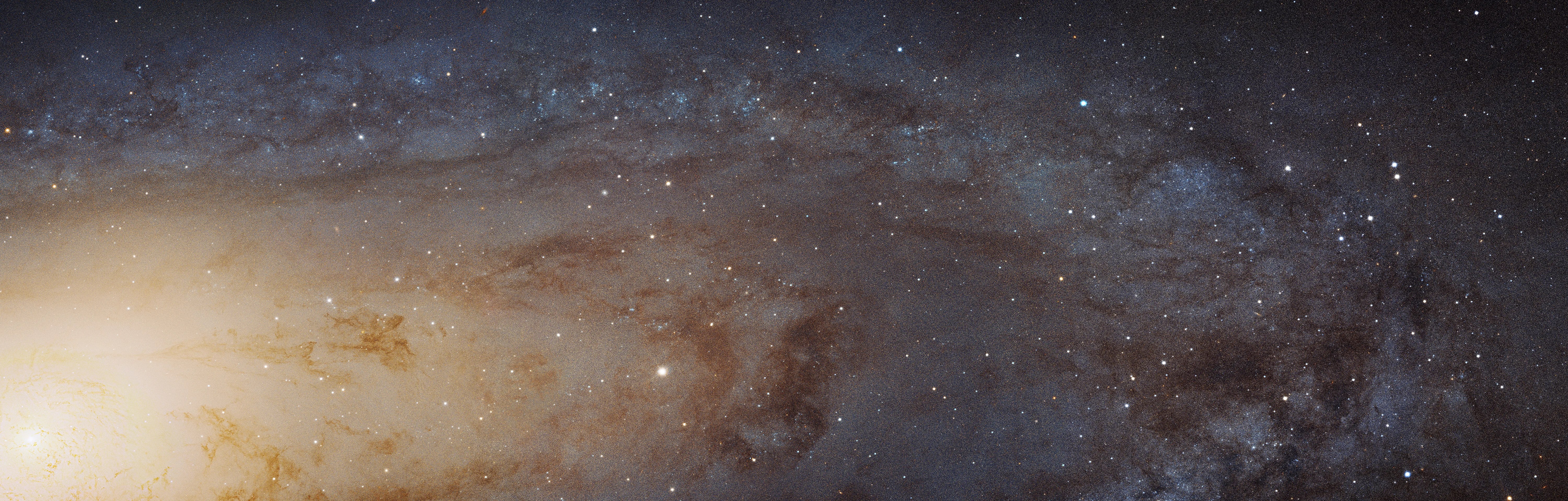
Illustration of the Andromeda Galaxy (M31) our nearest large galactic neighbour
A galaxy is a gravitationally bound system of stars, stellar remnants, interstellar gas, dust, and dark matter. The word galaxy comes from the Greek galaxias, meaning “milky” a reference to our own Milky Way galaxy. Galaxies range in size from dwarf galaxies with just a few hundred million stars to giant ellipticals containing one hundred trillion stars.
The observable universe contains an estimated two trillion galaxies, each separated from its neighbours by vast empty voids. Galaxies are rarely isolated; they cluster together under gravity into groups, clusters, and superclusters, forming the cosmic web that is the large-scale structure of the universe. Understanding how galaxies form and evolve is one of the central challenges of modern astrophysics.
Types of Galaxies
American astronomer Edwin Hubble developed the first classification system for galaxies in 1926, known as the Hubble Sequence or Hubble Tuning Fork. The system classifies galaxies into four main morphological types based on their visual appearance.
- Spiral Galaxies
- The most visually striking type, spiral galaxies have a flat, rotating disc with curved arms of stars, gas, and dust spiralling outward from a bright central bulge. The Milky Way and the Andromeda Galaxy (M31) are both spirals. Approximately 60% of all observed galaxies are spirals.
- Barred Spiral Galaxies
- A subtype of spiral galaxies where the spiral arms emerge from the ends of a central bar-shaped structure of stars, rather than directly from the nucleus. The Milky Way is now classified as a barred spiral (SBbc). About two-thirds of all known spiral galaxies have bars.
- Elliptical Galaxies
- Smooth, featureless, roughly ellipsoidal systems containing mostly old, red stars with little interstellar gas or dust. They range from nearly spherical (E0) to very elongated (E7). The largest galaxies in the universe are giant ellipticals found at the centres of galaxy clusters.
- Lenticular Galaxies
- Intermediate between spirals and ellipticals, lenticular galaxies have a disc structure but no distinct spiral arms. They contain older stellar populations and have largely exhausted their star-forming gas and dust.
- Irregular Galaxies
- Galaxies that do not fit into the regular Hubble classification, often because they have been distorted by gravitational interactions or mergers with other galaxies. The Large and Small Magellanic Clouds, two satellite galaxies of the Milky Way, are examples of irregular galaxies.
Famous Galaxies
- The Milky Way Our home galaxy, a barred spiral approximately 100,000 light-years in diameter containing 100–400 billion stars. The Solar System is located about 26,000 light-years from the galactic centre.
- Andromeda Galaxy (M31) The nearest large spiral galaxy, 2.537 million light-years away and containing roughly one trillion stars. Andromeda is on a collision course with the Milky Way and will merge in approximately 4.5 billion years.
- Triangulum Galaxy (M33) The third-largest member of the Local Group of galaxies, containing about 40 billion stars. It is the most distant object visible to the naked eye under dark skies.
- Sombrero Galaxy (M104) An iconic edge-on spiral galaxy with a bright nucleus and prominent dust lane, located 31.1 million light-years away. Its bright bulge resembles a sombrero hat.
- Whirlpool Galaxy (M51) A classic grand-design spiral galaxy interacting with its companion NGC 5195. Their gravitational interaction triggers star formation in M51’s spiral arms, giving it a particularly vivid appearance.
Local Group Galaxy Data
The Local Group is the galaxy group that includes the Milky Way and approximately 54 other galaxies, spanning a volume of about 10 million light-years. The table below shows key data for the major members.
| Galaxy | Type | Distance from MW | Diameter | Stars (Approx.) |
|---|---|---|---|---|
| Milky Way | Barred Spiral | 0 | ~100,000 ly | 100–400 billion |
| Andromeda (M31) | Spiral | 2.537 million ly | ~220,000 ly | ~1 trillion |
| Triangulum (M33) | Spiral | 2.73 million ly | ~60,000 ly | ~40 billion |
| Large Magellanic Cloud | Irregular | ~160,000 ly | ~14,000 ly | ~30 billion |
| Small Magellanic Cloud | Irregular | ~200,000 ly | ~7,000 ly | ~7 billion |
The Milky Way – Andromeda Collision
The Milky Way and the Andromeda Galaxy are approaching each other at approximately 110 kilometres per second. In about 4.5 billion years, the two galaxies will collide and eventually merge into a single, larger elliptical galaxy sometimes called “Milkomeda”. Despite the dramatic scale of this collision, the vast distances between individual stars mean that stellar collisions will be extremely rare. Our Sun will survive, though it may be flung into a very different orbit within the new merged galaxy.
Five Most Famous Galaxies
- The Milky Way Our home galaxy, a barred spiral galaxy containing 200–400 billion stars, stretching approximately 100,000 light-years across. Earth is located about 26,000 light-years from the galactic centre.
- Andromeda (M31) The nearest large galaxy to the Milky Way, at 2.537 million light-years away. Andromeda is on a collision course with our galaxy and is expected to merge with the Milky Way in about 4.5 billion years.
- Triangulum Galaxy (M33) The third-largest galaxy in the Local Group, a small spiral galaxy visible to the naked eye under very dark skies. It contains approximately 40 billion stars.
- Sombrero Galaxy (M104) A striking edge-on spiral galaxy with a bright white core and a dark dust lane, located about 31 million light-years away in the constellation Virgo.
- Whirlpool Galaxy (M51) A classic interacting spiral galaxy located 23 million light-years away. Its beautiful spiral arms, highlighted by star formation, were first noted by Charles Messier in 1773.
Explore stunning galaxy imagery at the Hubble Space Telescope Gallery.