Our Solar System
☀ Eight Planets, One Star, Infinite Wonder
Jump to Section
Our Solar System formed approximately 4.6 billion years ago from a giant cloud of gas and dust called a solar nebula. The Sun contains 99.86% of the Solar System’s total mass, while the eight planets, dozens of moons, and countless smaller bodies make up the remainder. From the blazing surface of Mercury to the frigid outer reaches of Neptune, the diversity of worlds in our cosmic neighbourhood is staggering.
Studying the Solar System has driven some of humanity’s greatest achievements in science and technology. The space age, beginning with Sputnik in 1957, unlocked direct exploration through robotic probes, landers, and crewed missions. Today, spacecraft like the Perseverance rover on Mars and the Juno orbiter around Jupiter continue to send back groundbreaking data about our neighbouring worlds.
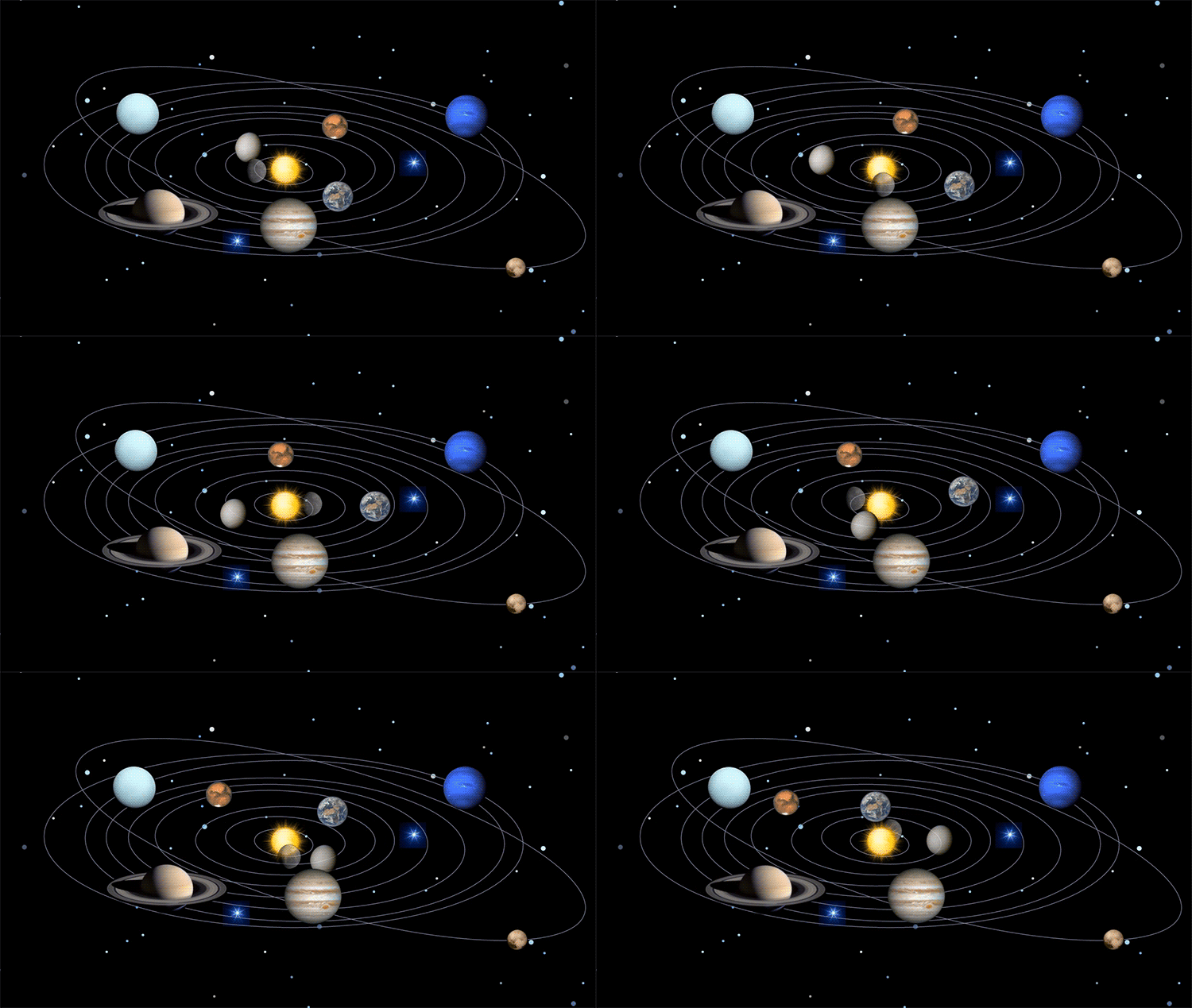
The Sun
The Sun is a G-type main-sequence star (also called a yellow dwarf) located at the centre of our Solar System. With a diameter of approximately 1.39 million kilometres, it could contain more than one million Earths. The Sun’s core temperature reaches an astounding 15 million°C, where nuclear fusion converts hydrogen into helium, releasing the energy that makes life on Earth possible.
The Inner Planets
The four inner planets Mercury, Venus, Earth, and Mars are known as the terrestrial planets because they have solid, rocky surfaces. They are smaller and denser than the outer gas and ice giants, and are separated from the outer planets by the Asteroid Belt.
- Mercury Rocky
- The smallest planet and closest to the Sun. Mercury has no atmosphere to retain heat, so temperatures swing from −180°C at night to 430°C during the day. A year on Mercury lasts only 88 Earth days.
- Venus Rocky
- Often called Earth’s twin due to similar size, Venus is the hottest planet at 465°C on average hotter than Mercury due to a runaway greenhouse effect. Its thick atmosphere is composed mostly of carbon dioxide.
- Earth Rocky
- Our home planet is the only known world harbouring life. Earth’s liquid water, protective magnetic field, and oxygen-rich atmosphere make it uniquely suited to support the diversity of life we observe today.
- Mars Rocky
- The Red Planet gets its colour from iron oxide (rust) on its surface. Mars hosts Olympus Mons, the tallest volcano in the Solar System at 21.9 km high, and is a prime candidate for future human exploration.
The Outer Planets
Beyond the Asteroid Belt lie four massive outer planets: Jupiter and Saturn (the gas giants) and Uranus and Neptune (the ice giants). These worlds are fundamentally different from the terrestrial planets, possessing thick gaseous or icy atmospheres and no solid surface to stand on.
- Jupiter Gas Giant The largest planet, with a Great Red Spot storm that has raged for centuries. Jupiter has at least 95 known moons, including Europa which may harbour a subsurface ocean.
- Saturn Gas Giant Famous for its spectacular ring system made of ice and rock. Saturn is the least dense planet it would float if placed in a large enough body of water.
- Uranus Ice Giant Unique for rotating on its side (97.77° axial tilt), Uranus has a cold atmosphere reaching −224°C, making it the coldest planetary atmosphere.
- Neptune Ice Giant The farthest planet from the Sun, Neptune experiences the fastest winds in the Solar System at speeds up to 2,100 km/h. Its moon Triton orbits in retrograde (opposite to Neptune’s rotation).
Planet Comparison Table
The table below compares key characteristics of all eight planets, arranged in order of distance from the Sun. Data is sourced from NASA’s Planetary Fact Sheet.
| Planet | Type | Diameter (km) | Distance from Sun (AU) | Orbital Period | Known Moons |
|---|---|---|---|---|---|
| Mercury | Rocky | 4,879 | 0.39 | 88 days | 0 |
| Venus | Rocky | 12,104 | 0.72 | 225 days | 0 |
| Earth | Rocky | 12,756 | 1.00 | 365.25 days | 1 |
| Mars | Rocky | 6,792 | 1.52 | 687 days | 2 |
| Jupiter | Gas Giant | 142,984 | 5.20 | 11.9 years | 95 |
| Saturn | Gas Giant | 120,536 | 9.58 | 29.5 years | 146 |
| Uranus | Ice Giant | 51,118 | 19.2 | 84 years | 28 |
| Neptune | Ice Giant | 49,528 | 30.1 | 165 years | 16 |
Key Facts About the Solar System
Major Solar System Discoveries (Chronological)
- 1543 → Copernicus proposes the heliocentric model of the Solar System.
- 1610 → Galileo discovers Jupiter’s four largest moons with his telescope.
- 1781 → William Herschel discovers Uranus, doubling the known Solar System.
- 1846 → Johann Galle observes Neptune, predicted by mathematical calculations.
- 1930 → Clyde Tombaugh discovers Pluto (later reclassified as a dwarf planet).
- 1972 → Pioneer 10 becomes the first spacecraft to enter the Asteroid Belt.
- 2015 → NASA’s New Horizons conducts the first flyby of Pluto.
For the most up-to-date Solar System exploration news,visitNASA’s Solar System Exploration website .